How do you measure the right size for workwear?
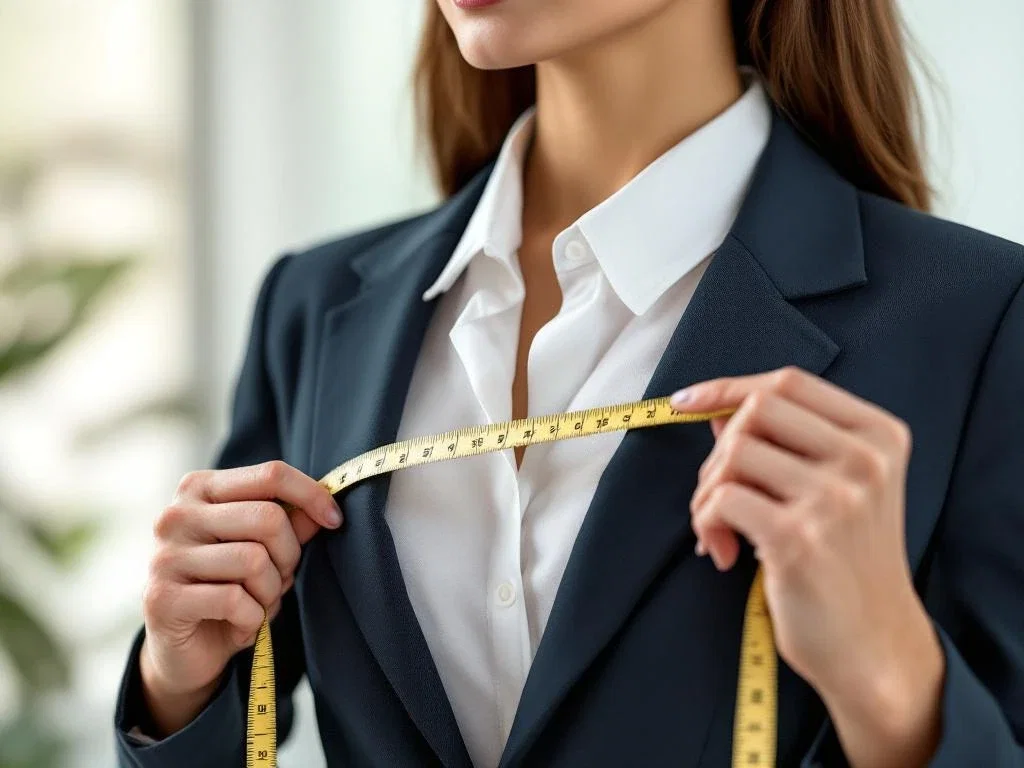
To find the right workwear size, you take three key measurements: your bust at its fullest point (wearing a bra), your waist at its narrowest, and your hips at their widest. Use a flexible tape measure, keep it horizontal, and make sure it sits snugly without pinching. Measure in the morning for the most accurate results and compare your measurements with the size chart of the specific brand.
Why is the right workwear size so important?
The right workwear size doesn’t just determine your comfort throughout the workday, it also directly affects your professional look and self-confidence. Comfortable workwear that fits perfectly gives you the freedom of movement you need for all your daily tasks, whether you sit, stand, or move around a lot.
Clothing that’s too tight restricts your movement and can cause discomfort, while clothing that’s too loose looks sloppy and can undermine your professionalism. A good fit means you feel comfortable all day, so you can focus on your work instead of constantly thinking about your clothes.
On top of that, well-fitting workwear has a positive effect on your posture and presence. Clothing that drapes beautifully flatters your figure, contributing to a polished, professional image. This not only boosts your own confidence but also makes a better impression on colleagues, clients, and business contacts.
Which body measurements do you need for workwear?
To determine the right workwear size, three basic measurements matter most: bust, waist, and hips. These measurements form the basis for almost every garment, from blazers and blouses to pants and dresses. Inseam, arm length, and shoulder width are also relevant for specific items.
Measure your bust at its fullest point, ideally wearing the bra you usually wear. This measurement is especially important for tops such as blazers, blouses, and dresses. Measure your waist at the narrowest point of your midsection, usually just above your navel. This is the key measurement for pants, skirts, and fitted garments.
Measure your hips at their widest point, usually about 20 centimeters below your waist. This measurement is especially relevant for pants and pencil skirts. For pants, your inseam also matters – measure from your crotch to where you want the pants to end. For blazers and blouses, arm length can be relevant, measured from your shoulder to your wrist with your arm slightly bent.
Shoulder width is especially important for closely tailored blazers and blouses. Measure from one shoulder point to the other, across the back of your shoulders. Together, these measurements give you a complete picture for finding workwear that fits your body perfectly.
How do you best measure yourself for workwear?
Measuring correctly starts with the right preparation and tools. Use a good-quality flexible tape measure and wear underwear or thin, close-fitting clothing while measuring. Stand up straight with your feet hip-width apart and breathe normally – don’t suck in your stomach, as this gives a distorted result.
For your bust, place the tape measure horizontally around the fullest part of your bust, usually at nipple height. The tape should sit comfortably without digging in. For your waist, first find your natural waist – bend to the side; where the crease forms is your waist. Measure around this point, keeping the tape parallel to the floor.
Measure your hips about 20 centimeters below your waist, at the widest point of your hips. Again, keep the tape horizontal and make sure it’s equally snug all around. For your inseam, it’s best to stand up straight and measure from your crotch to the desired length along the inside of your leg.
The most common measuring mistakes are: measuring too tightly (the tape should be able to move), measuring at an angle (use a mirror to check), and measuring over bulky clothing. Ideally, measure in the morning when your body is least swollen, and write down all measurements right away. Measure yourself twice to avoid mistakes.
What’s the difference between Dutch and international sizes?
Dutch clothing sizes differ considerably from international sizing systems, which is especially important when shopping online or buying international brands. The Dutch system uses numerical sizes such as 36, 38, 40, while other countries often use letters (S, M, L) or other numbering systems. A Dutch size 38, for example, corresponds to a European 38, but to a UK 10 and a US 6.
Fortunately, the European sizing system is largely the same as the Dutch system, which makes shopping within Europe easier. The British system runs about 28 numbers lower than the Dutch one – so an NL 40 is a UK 12. The American system differs even more, with numerical sizes running about 32 numbers lower.
It’s important to know that differences can exist between brands even within the same size label. Italian brands, for example, often run smaller than Dutch ones, while American brands can run larger. Scandinavian brands often use their own size charts that deviate from standard EU sizes.
When converting sizes, it’s always wise to consult the brand’s specific size chart. Don’t rely blindly on general conversion charts; instead, compare your body measurements with the centimeter measurements the brand provides. This gives the most reliable indication of the right size.
How do you use a size chart for workwear?
Using a size chart correctly starts with finding the right column for your measurements. Most charts show clothing sizes (XS, S, M, L or 36, 38, 40) in the first column, followed by the corresponding body measurements in centimeters. First look up your measured bust, waist, and hips in the chart and see which clothing size matches.
Pay particular attention to the differences between slim fit, regular fit, and relaxed fit within the same brand. A regular fit size M might list a bust of 88-90 cm, for example, while a slim fit M might use 84-86 cm. Comfortable workwear in a regular fit usually offers more room to move, while slim fit sits closer to the body for a sleeker silhouette.
If your measurements fall into different sizes – for example, an S for your bust but an M for your hips – choose the size that fits the most important part of the garment. For a blazer or blouse, your bust is decisive; for pants or a skirt, your hips. For dresses, go by the largest of your three measurements.
Brand-specific size charts always take precedence over general charts. Every brand has its own fits and sizing, so a size 40 from one brand may fit differently than from another. That’s why it’s a good idea to save the size charts of brands you’re happy with, so you can choose the right size right away next time.
What do you do if you’re between two sizes?
When your measurements fall right between two standard sizes, the best choice depends on several factors: the type of garment, the fabric, and your personal fit preference. If you’re unsure between, say, size 38 and 40, with your measurements right on the border, it’s usually wise to choose the larger size for optimal comfort.
The fabric composition plays an important role in this choice. Materials with stretch, such as elastane, offer more flexibility, so you can more easily choose the smaller size. Pants made of 87% polyamide and 13% elastane, for example, will give and adapt to your body. With stiffer, non-stretch materials such as 100% cotton or wool, the larger size is often more comfortable.
Your personal preference for how clothes fit also matters. Do you love close-fitting clothing that emphasizes your figure? Then go for the smaller size in stretch fabrics. Do you prefer more freedom of movement and a looser fit? Then choose the larger size, especially for workwear you need to move comfortably in all day.
Think about layering too – if you often wear a blouse under your blazer, one size up may feel nicer. For pants: if only your hips fall between two sizes but your waist fits comfortably within the smaller size, you can often take the smaller size. The waistband can be taken in if needed for a perfect fit.
Which workwear fit suits your figure best?
Choosing the right fit depends on your body shape, personal style, and work environment. Straight fit workwear offers a classic, straight line from shoulder to hem or from hip to ankle. This timeless fit flatters almost every figure and offers enough room to move without being too wide, perfect for a professional look.
Slim fit clothing sits closer to the body and emphasizes your natural shape. This modern fit works especially well on a slim or athletic build and gives a sleek, contemporary look. Do make sure the fabric has enough stretch for comfort during long workdays. For an hourglass figure, slim fit is often very flattering.
Relaxed fit offers the most freedom of movement with a looser fit throughout the garment. This comfortable option is ideal for active workdays or when you prioritize comfort over a sleek silhouette. For apple-shaped figures or a fuller tummy, relaxed fit is often the most flattering solution.
Tailored fit is the perfect middle ground between slim and regular fit. This fit follows your body’s natural lines without being too tight, with strategic seams that create a streamlined look. For pear-shaped figures, tailored fit works beautifully, especially paired with slightly wider pants that balance the hips.
How do you avoid the most common mistakes when choosing workwear?
The biggest mistake when choosing workwear is blindly relying on your usual size without measuring or checking the size chart. Sizes vary between brands, and your body can change over time. So always measure yourself again, especially with a new brand or after a change in weight. Compare your measurements with the brand’s specific size chart for the best fit.
Clothing that’s too tight is a common pitfall, often chosen out of vanity or in the hope it will motivate weight loss. This results in uncomfortable workdays, visible seams and creases in unflattering places, and clothing that wears out faster. Test your freedom of movement by bending, reaching, and sitting – if it pinches or pulls, it’s too small.
Clothing that’s too loose is problematic too and gives a sloppy, unprofessional impression. Shoulder seams sliding off your shoulders, sleeves falling over your hands, or pants bunching on your shoes undermine your professional look. The right size fits comfortably without excess fabric.
Don’t forget to account for shrinkage, especially with natural materials such as cotton. Wash new clothing according to the care instructions before deciding for sure whether the size is right. Materials with a high percentage of polyester or polyamide shrink less but may stretch slightly over time. Choose your size with these properties in mind for long-lasting wearing pleasure.
How &Co Woman helps you find the right workwear size
&Co Woman offers a complete solution for finding perfectly fitting workwear, with clear size charts and personal size advice. The shop offers several benefits that make choosing the right size easier:
- Detailed size charts per garment with exact centimeter measurements
- Clear fit advice for every product (slim fit, regular fit, relaxed fit)
- Personal styling and size advice via chat or phone
- Generous return options so you can try things on at home at your leisure
- Reviews from other customers about the fit of each item
- Quality clothing that keeps its shape after many washes
Discover the workwear collection that perfectly suits your size and style at & Co Woman. Visit &Co Woman and experience the difference of workwear that truly fits – for more comfort and confidence in your daily work.
Frequently Asked Questions
How often should I remeasure myself for workwear?
It’s wise to check your measurements every 6-12 months, or right after a weight change of more than 3 kilos. Remeasuring is also essential when switching to a new brand or after a pregnancy, as your body proportions may have changed. Save your measurements in a note on your phone with the date for easy reference.
Is it best to try on workwear in the morning or in the evening?
Ideally, plan fittings in the late morning or early afternoon, when your body has its natural shape. Early in the morning your body may be slightly slimmer, while toward the evening you’re often a bit swollen due to fluid retention. For the most realistic fit, avoid trying things on right after exercising or a heavy meal.
What do I do if workwear I ordered online doesn’t fit well despite following the size chart?
Make use of the return policy and, when in doubt, order two adjacent sizes to try on at home at your leisure. Keep track of which size you wear in which brand in a personal ‘size log’. Also check other buyers’ reviews about the fit – does the brand run large or small? For persistent fit issues, a tailor can make small alterations for a perfect fit.
How do I know if my workwear looks professional enough when I choose comfort?
Comfortable and professional aren’t mutually exclusive – choose quality fabrics with a small percentage of stretch (2-5% elastane) that keep their shape but move with you. Test your outfit by taking photos of yourself from different angles. A good fit means the clothing drapes smoothly without pulling at the buttons, shows no horizontal creases, and follows your silhouette without pinching.
What alterations can a tailor make if my top and bottom sizes differ significantly?
An experienced tailor can take in or let out the waist of pants and skirts by about 4 centimeters without affecting the overall fit. On blazers, the side seams can be taken in for better waist shaping. For dresses, adjusting the waist and bust lines is possible. Invest in these alterations for more expensive basics you wear often – the cost is outweighed by years of perfectly fitting workwear.
How do I recognize quality clothing that keeps its fit after lots of wearing and washing?
Look for dense weaves and materials with 60-80% natural fibers blended with technical fibers such as polyamide or a small percentage of elastane. Check the seams – double stitching and finished seams are signs of durability. Avoid overly thin fabrics that become see-through when stretched. Brands that use pre-shrunk fabrics retain their shape and size better.